Showing posts with label Bansal. Show all posts

Thursday, April 11, 2019

Simran Bansal, Gooding-Williams vs. Morton Response

The depictions of history and class relations in Disney’s The Lion King have been analyzed through multiple lenses by scholars such as Robert Gooding-Williams and John Morton. I don’t necessarily think that one argument was inherently wrong per se because it is in our nature as viewers to subjectively interpret texts according to our own values and beliefs. However, Morton’s argument definitely convinced me more. I will begin by analyzing Robert Gooding-Williams’ analysis in his article, “Disney in Africa and the Inner City: On Race and Space in The Lion King,” since it was published first.

First, Gooding-Williams stresses that Disney largely borrows from the Eurocentric ideology of G.W.F. Hegel, devaluing the richness of the African continent by reducing it “to the endless reproduction of a natural and pre-historic course of life.” According to William-Goodings, the “circle-of-life” theme is actually belittling to the African continent, for it implies that no progress or cultural advancement is made in that primitive “other” part of the world. However, I don’t buy this. I honestly don’t think Disney was intentionally trying to imply that there was no room for improvement and maturation to occur in Africa’s future. Instead, to me, the circle-of-life theme was an uplifting message that we need to accept highs and lows as natural components of life. In addition, the “circle of life” as described in the movie was mainly referring to the literal depiction of all life forms on nature as interconnected and united in the end. For example, Mufasa explains to Simba that from the smallest ant to the most ferocious lion, all animals are more alike than they are different—despite the grand diversity that exists, all organisms are simply trying to make their way in this world and thus should exist in a beautiful harmony.

Moreover, William-Goodings argues that although the film takes place in Africa, Disney really transforms Africa into “an allegory of American political life that denies that inner city blacks and Latinos have a rightful place in the American polity.” For his evidence, he cites that the hyenas that live in the Elephant Graveyard outside of the Pride Rock boundaries are analogous to discriminated minorities living in America’s inner cities because Whoopi Goldberg and Cheech Marin, who voiced two of the three main hyenas, were chosen to exude African American and Latino slang respectively. But, in his argument, Gooding-Williams overlooks one key piece of information: many main characters were voiced by minority ethnicities, not just the hyenas. Many of the “good” characters such as Mufasa, Nala, Rafiki, and Sarabi were voiced by African Americans too, so according to Gooding-Williams argument, Pride Rock should then also be considered a manifestation of America’s inner cities. In addition, Gooding-Williams points to the scene where the hyenas are lined up before Scar, claiming the backdrop is the “unambiguous image of a housing development in the projects.” However, as one can see from the image below, the backdrop simply looks like a tall grey structure—can’t that also represent a skyscraper, an ingenious engineering feat?
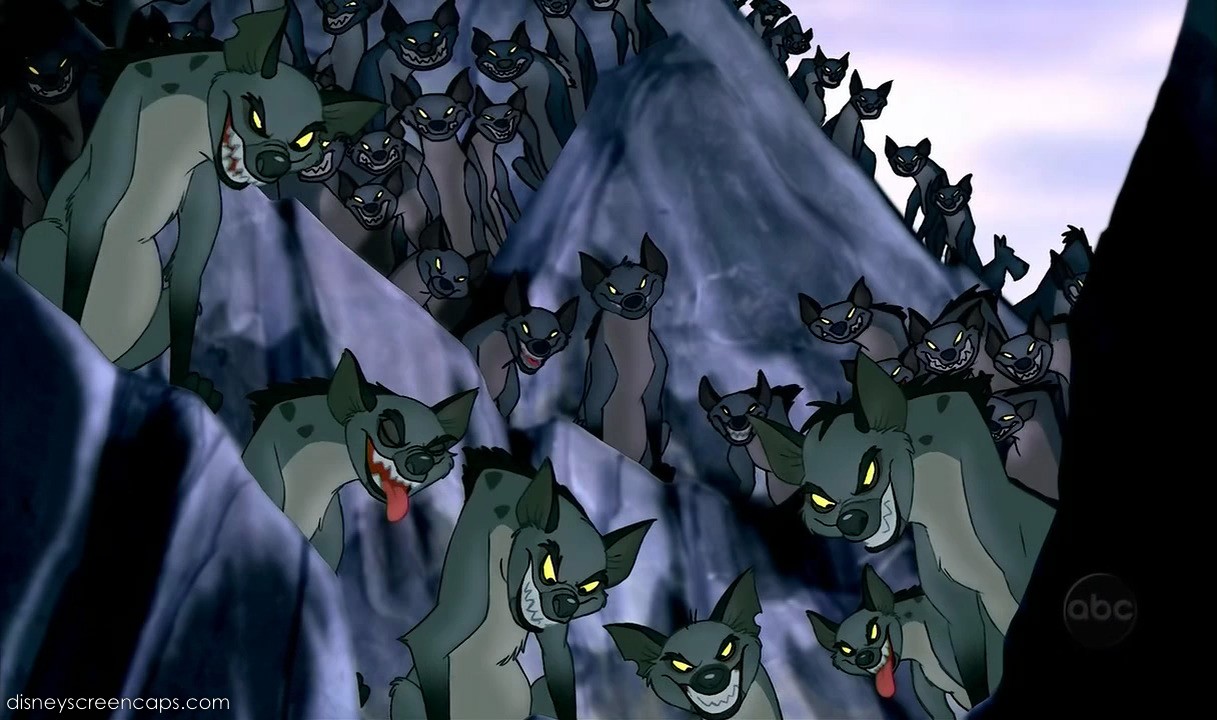
Finally, my last major problem with Gooding-Williams’ argument was his characterization of Rafiki. He explains that while the hyenas represent angry, assertive Blacks who seek political enfranchisement, Rafiki represents a distinct type of African American who does not fight for the rights of his people, but instead subserviently follows the will of the White folk. As Morton effectively points out, there is nothing that connects Rafiki to the hyenas, nor any convincing evidence that Rafiki is meant to represent an outsider too. In fact, as Morton argues, Timon and Pumbaa are more connected to the hyenas than Rafiki, for they are at the bottom of the food chain, consuming only “lowly grubs and beetles.” Thus, I do not think that Rafiki (a valued and trusted ally of Mufasa, the king of Pride Rock) should be characterized as an outsider who has abandoned his own kind, for there is little to suggest that he does not belong to the kingdom of the light.

Furthermore, what I really appreciated with Morton’s piece, “Simba’s Revolution: Revisiting History and Class in The Lion King,” was that Morton did not merely disagree with everything Gooding-Williams had to say, but he stated that while what Gooding-Williams stated could be a possibility, the film should be interpreted with a broader mindset. I agree that the film is “less black and white than Gooding-Williams recognises” because Scar is not the only revolutionary looking to ignite change, nor is corruption “restricted to a particular region.” While Scar does aim to create change by altering the “circle of life,” Simba aims to create change by altering the “circle of death” created by his Uncle. In addition, Simba’s unexpected brotherhood with Timon and Pumbaa, two creatures who are at the bottom of the hierarchy, shows that meaningful relationships can transcend physical boundaries and social class, thus blurring the separation between Pride Rock and the outside lands. In essence, Morton’s argument is more effective, for he shows that Gooding-Williams is too narrow-minded and simplistic in his analysis.

Wednesday, April 3, 2019

Simran Bansal, Disney's The Lion King Response

There is a reason why since its initial release in 1994, The Lion King has remained one of the highest grossing animated films of all time: it’s an incredibly heartwarming and universal story of growing up and the inevitable journey towards self-discovery that comes with it. Watching it for the first time in a long time, I can see why it has remained my indisputably favorite Disney movie ever—I am able to find a piece of myself in Simba, as I’m sure we all can. After all, aren’t there times in life when we all lose sight of who we are? When we don’t feel like we are worthy enough to emerge as leaders and be surrounded with love? When we think running away from the past, instead of facing our shortcomings head on, can erase all our problems? I know that after I have experienced failure or disappointed myself (whether that’s after receiving a bad grade on an examination or saying something hurtful to a loved one), I have dreamt of running off to a far-off land to reinvent myself and start anew. Hence, after Simba thought he was responsible for Mufasa’s death and subsequently fled Pride Rock out of fear of disappointing his loved ones, it was as if those fantasies I had from time to time were acknowledged as valid. I found comfort in the “You’re not alone” message Disney was sending me. Through Simba, we learn that sometimes you have to lose yourself in order to find yourself. Simba must embark on his journey to Pumbaa and Timon before he can see that he was born to be a leader, and that because of that, he can’t avoid his responsibilities and live in a “Hakuna Matata” world devoid of worries for eternity. He owes it not only to all the lions relying upon him to restore Pride Rock as a kingdom of light and goodness but to himself to be the best, most genuine version of himself. Only once his faith in himself and his capacity to rule with greatness is restored can Simba embrace who he was meant to be—the fearless king of the land that the light touches. My favorite quote comes from Rafiki, the extremely wise baboon who reminds us that in life, the easier choice to make will be to run away from our past and escape reality. However, sometimes the more difficult choice (to acknowledge your mistakes and actually grow from them) is often the right one:


In addition, I appreciated how The Lion King taught viewers that we are all connected in “The Circle of Life.” This message is one that has the potential to unify us and show us that despite how it may appear, we are all one big family, more alike than we are different. Because of this interconnectedness, we must treat everyone with respect, even those who may seem like they are “lower on the food chain.” Especially today, in our current political environment, it is so important to remember that at our very core, we are all part of the same circle of life; hence, we should accept people for who they are, for in the end, they are just people too. I think it was clever to start the movie with the scene of Rafiki holding up the newly-born Simba and end the movie with the scene of Rafiki now holding up Simba and Nala’s newly-born cub—the theme of the circle of life was literally depicted through the circular narrative of the film. All in all, the “Circle of Life” theme serves to reinforce the notion that life ebbs and flows and has its ups and downs, but in the end, it keeps moving forward. Similarly, although we will experience our fair share of happy moments and tragedies, we must continue to progress and show fortitude.


Finally, one critique I have about the film was the way it portrayed the good guys (Simba and Mufasa) vs. the bad guys (Scar and the hyenas). Similar to Aladdin, the villains in The Lion King had noticeably darker skin than the protagonists, which can lead to the harmful and unfair connotation of dark skin as bad and paler skin as good. I understand that traditionally, darkness is associated with evilness, but at the same time, Disney must consider how this choice will only perpetuate the archaic notion that people of color have innately worse character qualities than those with light skin.

All in all, The Lion King gave me all the feels (see Simba and Nala below for an accurate portrayal of my reaction while watching the amazing and timeless classic)....


Monday, April 1, 2019

Simran Bansal, Sundiata: Lion King of Mali Response

Perhaps because of the bold, vibrant illustrations suffused with warm hues or because of the feel-good message that in the end, kindness and loyalty will triumph over evil (or, let’s be honest, the refreshing simplicity of the story following Macleod’s overly ambitious and winding argument), I really enjoyed reading Sundiata: Lion King of Mali by David Wisniewski. The visualization of the map at the beginning of the book was quite intriguing, especially since today in my Global Health 101 class, we discussed how drowning was a major contributor of morbidity and mortality in the West African region. After looking at this map, I can see why—the geography seems to be a huge maze of various rivers! In addition, similar to how we write “roadmaps” of our arguments in academic arguments, I interpreted this map as a preview of the long and twisting journey to come….

The first thing I noticed once I began reading the text was that it was unclear who was actually narrating the story. Although we were told that the story was told from the perspective of a griot—a member in Western African culture responsible for recounting oral history—we were never given a specific identity. However, as first person was only used in the first page of this book, it didn’t seem to matter either way. Another element of the story I was further interested in researching was the inspiration behind naming the land “Bright Country.” Did brightness have some cultural significance? Was it tied to a deeper religious meaning? Or was the land known as “bright” simply because the sun was always shining (although the first image is depicted at nighttime, with the huge crescent moon and the dazzling stars)? Upon further research, I realized that the origin behind the name was the product of all three factors. The “brightness” is a testament to the fact that “Bright Country” is located extremely close to the equator, so there is sunlight year-round. In addition, the soil of the area—like the illustrations of the book—is an intense yellow and red color, adding to the quality of vibrancy. Finally, since brightness is associated with the religious belief that light connects Earth to the spiritual realm, “Bright Country” is revered for being a magical place where the physical and spiritual worlds meet. Clearly, it’s a perfect setting for a story brimming with destiny and magic.

In addition, another character who interested me was the unattractive Sogolon, known to “possess the very spirit of [the] buffalo, strong and courageous.” Although I did not appreciate how Sogolon was literally treated like a material prize as opposed to a human being, this is unfortunately understandable considering the context of the story in an ancient society where women were viewed as property to be owned by men. However, I interpreted another more empowering message from the depiction of Sogolon—we do not have to be defined by our outward appearance. Instead, even those individuals who are not aesthetically beautiful can still possess a strong heart and mind. Similarly, even though Sundiata seemed to be limited by his disability at first, he was able to overcome his shortcomings through displaying his inner fortitude. This message that the only limitations that exist are those which we create for ourselves is one of hope. One thing I realized, however, was that although Sogolon was supposed to be “hideous,” she did not look any different than many of the other characters in the book. I found other artistic depictions of Sogolon (such as the one below), and in none of them did she have “monstrous eyes” that were “merely laid on her face” as the epic, “The Buffalo Woman,” phrases it.


Furthermore, the characterization of the “nine great witches” whom the jealous, power-hungry Sassouma called upon to kill Sundiata surprised me. I always associate “witches” as being innately and irrevocably evil forces who do not care whether or not their victims are genuinely good people. However, in this story, the witches would not kill Sundiata because they could not “hurt a heart full of kindness,” highlighting that Sundiata’s greatest power and weapon of defense was derived from his ability to show compassion to others. Hence, Sundiata was effectively saved by his own kindness.

Finally, I appreciated how David Wisniewski made it a point to include a “note” about the cultural and historical significance of the legendary story. The fact that Wisniewski was able to identify strong parallels between the plotline of the story and the actual rise of the Mali Kingdom helped me see that this story was probably far more genuine and historically accurate than “Aladdin and the Wonderful Lamp,” which was essentially just a Westernized product of the Frenchman Galland’s making.

All in all, I would say Sundiata: Lion King of Mali was my favorite of all the original texts we have read thus far.

Wednesday, March 20, 2019

Simran Bansal, Disney's Aladdin Response

Watching Disney’s Aladdin (1992) for the first time since beginning the course—since realizing how important it was to critically analyze Disney films and view them as more than just children’s entertainment—really made me see the movie in “a whole new world.” No longer did that world just center around the cute romance between Jasmine and Aladdin or the comical interaction between Abu and the Magic Carpet. Instead, I also noticed other, less magical elements such as cultural insensitivity and sexism.


For starters, as the American-Arab Anti-Discrimination Committee phrased it, the film only seemed to perpetuate the “tired stereotype of the Arab world as a place of deserts and camels, of arbitrary cruelty and barbarism.” For instance, in the marketplace when Jasmine inadvertently stole the apple, the owner of the market was ready to chop off her hand. This, to me, portrays Middle Eastern societies in an unfair, black-and-white sense where extreme Sharia law will always prevail. This inaccurate depiction can be extremely offensive to those viewers of Middle Eastern origin, for there is so much accomplishment and rich history concomitant to their cultural history that is blatantly ignored. In addition, another alarming element I noticed in the film was that while the “good guys” of the film, Aladdin and Jasmine, were depicted to have lighter skin tones, Anglicized features, and American accents, the villains such as Jafar and the palace guards tended to have Arabic accents and significantly darker skin tones. This is alarming, as it serves to reinforce notions of White superiority and puts forth the archaic idea that those of darker skin colors are innately more antagonistic/problematic than their paler counterparts. I wonder whether the animators purposely chose to illustrate the characters this way, or whether such a decision was the product of implicit bias. Either way, not the most culturally sensitive depiction to say the least….


Furthermore, I did appreciate how Jasmine was portrayed in a much more progressive light than the first-generation Disney princesses such as Snow White and Cinderella. For instance, I liked how Jasmine was a little fiesty and stood up against the misogynistic behaviors of the men in her life. For example, she didn’t passively sit by and just let her father decide her future husband. Instead, she cleverly drives the visiting princes whom she doesn’t like out of the palace with her rebellious behavior. Instead of unconditionally trying to please her father and obey the men in her life, Jasmine fights for her own desires and wishes. One of the lines that stood out most to me was when the Sultan, Aladdin, and Jafar were all arguing over the course of Jasmine’s future and Jasmine had the strength to assert that she was “not a prize to be won.” This iconic line helped shatter the sexist message suffused throughout the earlier text, “Aladdin and the Wonderful Lamp,” that women were similar to material objects who could just be handed off to the highest bidder.

However, there were still problematic depictions of gender roles. One character that annoyed me greatly throughout the entire movie was the Sultan. Not only was he a completely ineffective and useless leader (idly lounging in his luxurious palace while many children on the streets were literally begging to even eat a stale piece of bread), but his views regarding the capability of females were completely patriarchal. For example, he treated Jasmine as if she was weak and clueless, unable to make it on her own in this world without a strong male figure by her side. When he told Jasmine, “I’m not going to be around forever, and I just want to make sure you’re taken care of and provided for,” I physically cringed. See Genie below for an accurate portrayal of my response.
In addition, another question I had regarding the Sultan that bothered me throughout the film was if he had the power to change the law at his pleasure (i.e. he was able to change the law at the end of the film so that a Prince no longer had to marry the Princess), why didn’t he just change the law from the get-go so that Jasmine could inherit the throne and rule Agrabah? Was the idea that women could be leaders just too revolutionary for the Disney franchise to endorse? If a dim-witted character such as the Sultan was allowed to rule over the kingdom, Jasmine certainly should have the opportunity to do so as well.


Well, to end on a more positive note, I was super excited when I realized Genie was wearing a Goofy hat at the end of the film because Goofy has always been one of my favorite cartoon characters!!! Overall, the movie was super enjoyable to watch minus the cultural insensitivity, minus the sexism, and minus the fact that the well-being of the poor villagers was utterly overlooked.

Simran Bansal, #Shelfie


Monday, March 18, 2019

Simran Bansal, "Aladdin and the Wonderful Lamp" Response

Before reading “Aladdin and the Wonderful Lamp” as edited by Andrew Lang, I was expecting the text to be riddled with misogyny given the sexist nature of all the early fairy tale versions we have previously been exposed to. However, I was still genuinely shocked at just how horrifically the women in the story are treated. Honestly, I don’t understand how Disney could have been inspired to create an animated film based off of such a derogatory, twisted text.

For starters, the disobedient, greedy Aladdin shows no respect for his mother at all. He seems to call all the shots for the family after the father dies, even though she is his parent (and not the other way around). Even after the mother pleadingly begs Aladdin to get rid of the lamp, he flat-out refuses, essentially leaving the mother altogether powerless and voiceless.  Looking back at the story, Aladdin’s mother was not much different from the genie. She, too, was the “Slave of the Ring” who was made to oblige to Aladdin’s every last wish and demand (oh, and there were many). For example, Aladdin demanded that she go to the Sultan to secure his chance at marrying the Princess or else he would do some “desperate deed.” He was so controlling and obsessed with his own selfish desires that he was willing to threaten his poor mother without even a sliver of remorse for his actions. Clearly, the interactions between Aladdin and his mother put forth the flawed message that the desires of women do not matter. As the sole purpose of Aladdin’s mother in the story is to serve her son, it makes it seem as if the women exist not to attain their own dreams, but to fall in the shadows of dominating, powerful men.

If it is even possible, the treatment of the Princess in the story is even more abysmal. First, not only is she excluded from the title of the story, but she is made out to be so insignificant that she is never given a real name. That is how little the author thinks she matters. Speaking of value, the Princess is not treated as an actual human being with her own emotions and wishes, but as a mere material possession who can just be handed off to the highest bidder. When Aladdin’s mother presents the jewels, the Sultan asks the Vizier, “Ought I not to bestow the Princess on one who values her at such a price?” By implying that he is willing to just give his daughter away like a material good, he dehumanizes the Princess and essentially does away with her innate worth. In his eyes, the Princess is not a creature worthy enough to express her own thoughts in the matter of her future. Instead, she is a mere object, existing for the sole purpose of pleasing those who own her through her aesthetic appeal. Again, the fact that Aladdin madly falls in love with the Princess at first sight speaks to the idea that the only layer of her worth getting to know is surface-deep. Just as he is consumed by the glimmer of silver and gold, Aladdin is enthralled by the Princess’ outward beauty, completely disregarding the potential that she may not want to marry him. This story is so sexist that the idea that the Princess should have the power to voice her own opinion is not even depicted as absurd, for it is never considered to begin with.

Furthermore, the Princess is made out to be a lifeless object when Aladdin tells her, “You are my wife, promised to me by your unjust father.” Not once does he ask for her hand in marriage. He just tells her how it is. In the scene where Aladdin hastily climbs into bed with the Princess—dangerously resembling sexual abuse—not once does he ask for her consent to be close to her physically. He just acts as he pleases. I would argue that the most frightening part is that Aladdin doesn’t even realize that what he is doing is wrong, for the idea that women should be equal partners to men in relationships is irrevocably foreign to him. To make matters even worse, just as in rape cases where women are often portrayed to be at fault (i.e. by leading men on or “by asking for it” based on fashion choice), the Princess is not treated as a victim, but rather as guilty. Aladdin even goes as far as to tell her to “blame [her] beauty for [his] boldness.” All I can say is, “WOW. He has the nerve to violate her privacy and blatantly ignore her humanity and then claim that it was her fault all along?” It makes me sick to my stomach to think that women are not only grossly mistreated like this in fairy tales, but also in real life.

To add on to my long list of story elements that angered me was the depiction of the Princess as completely unintelligent and dim-witted. Not only does she give away the magic lamp without a thought, but she also fails to realize that “Fatima” is no holy woman, but actually the evil magician’s even more wicked younger brother in disguise. This message that women are air-headed and thus need men to save them and clean up messes created by their thoughtlessness is extremely disempowering, especially for female readers. After the Princess successfully poisons the magician’s evil younger brother, Aladdin isn’t even thankful for what she did. When she tries to embrace him, he pushes her away, for it is the lamp that he cares about more than her. This scene shows how little Aladdin actually cared for the way his wife felt. In his eyes, she was just a prized possession to flaunt the same way he showed off his wealth through bedazzled palaces and armies of slaves. He wasn’t interested in getting to truly know who she was as a person because he genuinely didn’t feel as if there was any substance to her besides her looks.

In essence, “Aladdin and the Wonderful Lamp” is an extremely misogynistic text that should not be praised, but should be criticized for accentuating archaic messages. This text should serve as a cautionary tale for all the ways women should not be treated. Instead, consumers should be sent the message that women, just as much as men, have the right to pursue their own dreams and forge their own paths.

Sunday, February 24, 2019

Simran Bansal, Disney's Mary Poppins Response

Penguin waiters. A Spoonful of Sugar. Supercalifragilisticexpialidocious. Chalk drawings that lead to new worlds. Laughter that defies gravity. And of course, a happily ever after. These are the images that suffuse Disney’s 1964 film, Mary Poppins, coming together to create a college of the airiness, joy, and ethereal magic that is quintessential of “The Disney Version.”

If this movie was not named Mary Poppins, I probably would not have even thought it was adapted from P.L. Travers’ earlier novel. The stark differences between the book and Disney’s adaptation are striking—a version that previously had a healthy balance of gloominess and of happiness and of the ups and downs concomitant to the trials and tribulations of life was replaced with a story of overwhelming positivity and upbeat music. In P.L. Travers’ novel, Mary Poppins was portrayed as more of a strict, cruel dictator who very much lived by the motto “my way or the highway.” However, in Disney’s remake (or perhaps, more appropriately, drastic reinvention) of the original story, although Mary Poppins is still stern and slightly vain, she becomes a much more mellow and understanding figure. She doesn’t automatically shoot down all of Jane and Michael’s wishes, but actually listens to some of their requests such as when they want to be transported to the quaint countryside depicted in the chalk drawing. This is the Mary Poppins I would want as my nanny—the cheery Julie Andrews who shows me tough love at times, but who also shows me joy and magic and the world.

There were many sentiments I appreciated about the movie, and many elements that left me disappointed. What I appreciated was the overarching message that I believe Disney was attempting to send his viewers: in life, if we look past the surface, we can find that great magic exists. Mary Poppins, time and time again, taught not only the other characters in the movie but also us that if we don’t take life for granted, we can be pleasantly surprised by its hidden depths. A seemingly boring task such as cleaning, for example, can be transformed into a “game” if we choose to experience it with the mindset that we can have fun. Life is, at its core, what we make of it. If we choose to see the carpet bag as an empty, odd-looking sack that can’t possibly carry many possessions, we will never be able to experience all the magic and possibility that lies within. When Mary Poppins miraculously pulls out objects from her bag such as a lamp that seem too big to be hidden within, Disney is reinforcing the notion that if we let go of our preconceived notions and expectations, we can discover unexpected magic and explore unventured territories. Again, this message to live with a flexible mindset is further enhanced through the scene with the chalk drawings. By using our imaginations, we are able to travel to uncharted worlds such as the English countryside that they travelled to in the film.

However, certain scenes and character dynamics in the film were problematic. For instance, although Disney portrayed Mrs. Banks as a staunch advocate of the women’s suffrage movement, by making her a neglectful, clueless mother, he also sent the message that perhaps she should solely focus on homemaking instead of putting her effort into a noble cause. In addition, although Mrs. Banks is progressive in her belief that women should vote, she seems hypocritical by not applying her women’s-empowerment ideals into her daily life. For instance, she lets Mr. Banks run the patriarchal household, and he is the one who makes the decisions for the family. By portraying the wife as subordinate to the husband, Disney is sending his viewers the message that women were meant to be followers while men were meant to be the leaders. The ending scene of the movie further undermines the significance of the women’s suffrage movement—by having Mrs. Banks use her “Votes for Women” sash to make the tail for the kite, Disney seems to be implying that Mrs. Banks cannot both pursue her advocacy rights and be a good mother at the same time. In the end, she must let go of her role in the suffrage movement so she can spend more time with her kids. Given how important the suffrage movement was to ensuring that women worldwide were given the rights they deserved, this message is rather archaic and frustrating.

Of course, in the end, Disney had to finish off with that much-expected “happily ever after.” I may have (ok, I definitely) rolled my eyes when everything seemed to perfectly fall into place, with Mr. Banks being made partner at the bank and both the Banks parents finally investing time and energy into their children’s lives. Could Disney have made the ending any more predictable? I certainly don’t think so. However, I do understand that the “happily ever after” had the important function of leaving viewers with a note of hope and optimism for the future. All in all, Mary Poppins was an entertaining movie to watch (I mean, who doesn’t love cute penguins dressed up as waiters?), but I was aware that many of the messages sent were problematic.

Monday, February 18, 2019

Simran Bansal, P.L. Travers' Mary Poppins Response

Before reading both Mary Poppins and Mary Poppins Comes Back by P.L. Travers, I only had a faint memory of watching the Mary Poppins movie as a child. What instinctively came to mind was an image of the sweet Julie Andrews singing “A Spoonful of Sugar” and being silly with her song, “Supercalifragilisticexpialidocious.” My preconceived notion of Mary Poppins as the ultimate dream nanny (I mean, what child wouldn’t want an adult to tell them that their problems would vanish by consuming sugar or make them laugh by creating ridiculously lengthy words?) was shattered as I began reading the novel. Instead, the questions that I kept asking—and now that I’m finished reading the book, have still annoyingly been left unresolved—are, “Why did the children love Mary Poppins so much when she was constantly rude and falsely accusing them of lying? Why did Mrs. Banks let Mary Poppins even come back in the first place, when she so disrespectfully left without warning? If Mary Poppins was so obsessed with her own image and with being superior to those around her, why did she lie about her magical qualities instead of flaunt them for the world to see?”

Like I said, Mary Poppins was far from the maternal, heroic figure I envisioned her to be. Instead, she was unnecessarily sharp to the point of being a tyrant, extremely narcissistic, and incredibly stubborn. We all know those arrogant people who think that they are always right and that just because they possess certain values, everyone must have those same values. In other words, they think that their truth is the only truth, that their opinion is actually fact—undoubtedly, Mary Poppins is one of those people. For some unfathomable reason, despite all her character flaws, Mary Poppins seemed to be worshipped by the other characters (especially the children) throughout both the books, though she seemed to show little respect in return. She literally made Jane and Michael wait outside in the freezing cold just so that she could look at her own reflection in the mirror, and yet, when she is gone, everything seems awry in the world.

Mary Poppins is undoubtedly a peculiar character. Perhaps we can’t really understand why Mary Poppins behaves the way she does because she doesn’t even know who she really is, grappling to find her own identity. I believe that Mary Poppins struggles to form a close attachment to the children because she really just doesn’t know how to connect to others. For her whole life, Mary Poppins has been alone in her oddities….She is the one child who didn’t forget how to communicate with the animals as she grew older. She is neither completely human nor completely mythical, so perhaps she just never gained that essential sense of belonging we all yearn for. Though she experiences other-worldly events such as kissing the sun and making London ready for spring, these magical occurrences always come to an end. Her life is full of uncertainty, the changing wind guiding her from place to place, hindering her from permanently settling down. In a way, I pity Mary Poppins—what is the point of having such amazingly magical qualities if you have no one you truly love to share them with? Michael has Jane, the twins have each other, Mr. Turvy has Miss Tartlet, and the Prime Minister has Lady Muriel Brighton-Jones, yet Mary Poppins is alone. She can’t even touch the one figure she seems to have a deeper, romantic connection with without getting burned. The last image we are left with at the end of Mary Poppins Comes Back is one of Mary Poppins riding away into the night sky on an empty carousel, a distant star millions of miles away from interpersonal contact.

Finally, the last thing I noticed was that the chapters became extremely repetitive, with the chapters in the second book closely mirroring those in the first book. For example, in the first book, there is a chapter, “Bad Tuesday,” where Michael is extremely naughty; in Mary Poppins Comes Back, the chapter “Bad Wednesday” is exactly like its earlier counterpart, except this time it is Jane who doesn’t listen. In the first book, John and Barbara have conversations with the wind and the bird, convinced they will forever be able to remember the language of nature; in the second book, it is Annabel who thinks that like Mary Poppins, she too will not forget how to communicate with the Starling. I wonder if P.L. Travers received any criticism for her seeming lack of creativity and inability to explore new depths from novel to novel.

In essence, Mary Poppins is a multifaceted, complex character—her cold exterior may be a product of the fact that she has had to go through the stages of her volatile life without anyone who can truly relate to her situation.

Thursday, January 24, 2019

Simran Bansal, Disney's Snow White Response

If I’m being completely honest, what struck me most about Disney’s Snow White and the Seven Dwarfs was just how slow the storyline moved and how boring it was. Disney spent several minutes on rather mundane scenes such as when Snow White spent all day cleaning up the house so the dwarfs would let her stay as a guest. If you didn’t already know, watching someone scrub dishes for 10 minutes straight is not the most interesting thing in the world. Anyways, this was a pattern throughout the movie—as Zipes stressed in his argument, Disney did not care so much for the actual storyline of the movie as he did for impressing audiences with brilliant, high-tech animations, visuals, and sounds. Rather than focusing on creating multi-dimensional, interesting characters, Disney’s main concern was making sure audiences were transported to the setting of the movie through fast-moving, lively depictions. Why do you think Disney included so many birds, deer, turtles, and rabbits in the movie? So that there would constantly be astonishing movement. Why do you think Disney extended the scene of poor Snow White running helplessly through the dark, creepy woods? So the animations of the sinister eyes and clutching hands of the trees could both petrify and amaze viewers simultaneously.


In addition, what really annoyed me about the movie was Snow White herself. You would think that after all she had been through—being mistreated by the Queen, being almost killed by the hunter, and being thrown into the unfamiliar woods—she would have developed some sort of spine or strength. However, throughout the movie, Snow White proves to be helplessly and utterly dependent on others. First, she relied on the huntsman not to kill her. Then, without the help of the animals and dwarfs, she probably wouldn’t have been able to survive on her own in the woods. Finally, she is completely dependent on the prince to wake her up after she eats the poisonous apple. By depicting Snow White as a wimpy, fragile girl constantly in need of saving, Disney reinforced the conservative, outmoded stereotype that women are unable to be independent and need to rely on men for support. As with the Grimm Brothers, Disney’s work of creation is deeply intertwined with patriarchal messages. By creating a scene where Snow White went into the woods to pick flowers while a man was a hunter, Disney took the depiction of traditional gender roles way back to before civilized societies even existed, when women in tribes were gatherers and men were hunters. In addition, Disney’s choice to make Snow White all sad and mopey, singing “someday my prince will come” and yearning for her true love to carry her off into the sunset, puts forth the flawed message that women need to rely on male figures in order to be happy. I don’t know about you, but that is certainly not a lesson that I would want to teach young girls. Talk about the opposite of empowering.


Finally, another concept I found fascinating, first introduced to me by Zipes, was Disney’s striking similarities to the Prince and how the Prince was essentially a manifestation of Disney himself. The Prince did not play a major role throughout the movie, but suddenly appeared at the end of the film, kissed Snow White, and rode off into the sunset with the beloved, beautiful princess herself. He did not do the grunt of the work, and yet, he received the entire “reward” (although it is cringey to call Snow White a reward, because it makes her seem like a possession someone can take ownership of instead of an actual free human being). The dwarfs were the ones who opened up their home to a complete stranger. The dwarfs were the ones who tirelessly ran through the dark, rainy woods, chasing the evil Queen to the ledge she eventually fell off of and died from. And yet, how were the dwarfs repaid for all their hard work and effort? By being neglected and abandoned, left behind in the woods. Similarly, although there were many animators who worked for Disney who helped turn his vision to reality, Disney received all the credit. When we think of Snow White, we think of Disney—we don’t think of the workers who spent hours drawing tirelessly until their arms were sore.

Clearly, Disney’s Snow White and the Seven Dwarfs, although technologically innovative, was far from progressive or revolutionary in its storyline and the concomitant, underlying messages.

Simran Bansal, Grimm's Snow White Response

Upon finishing reading Snow White and the Seven Dwarfs as created by the Brothers Grimm, one thought came to mind: “Wow, if I read this at bedtime as a child, I most certainly would have had nightmares!” See, this version of our beloved classic fairytale is not the innocent chirping of the birds or romantic frolic of a princess and prince into the sunset we think of when we envision Snow White—instead, the Grimm version is dark and twisted, sending extremely patriarchal and archaic messages.


The first detail about Snow White that was too hard to ignore was her age—at just 7 years old (the same age as my brother whose biggest concerns include being able to successfully build his own Lego sets), Snow White is being thrown out of the house by a grown woman engrossed in a jealous rage against a mere child! The fact that the Queen feels threatened enough by a 7 year old that her life becomes consumed by her desperate quest to end Snow White’s life shows how ridiculously insecure the Queen is with her own beauty. If the glass mirror that holds so much power over the Queen and her happiness is interpreted as the male gaze, the message emphasized becomes even more inappropriate (if that is even possible). Because the glass mirror and its omnipotent judgement about “who’s most fairest of them all” dictate the Queen’s aspirations in life, the Grimm Brothers are endorsing the awful notion that a woman’s main purpose should be to strive to be seen as most beautiful through the eyes of men. This image of the insecure Queen lends itself to an overarching depiction of all women as powerless creatures whose destinies and life choices must be governed by patriarchal figures. In addition, by focusing only on outward beauty as a measure of the Queen’s self-worth, this fairytale sends the twisted idea that to be “the fairest,” the size of one’s heart and one’s capacity to do good are both irrelevant. Emphasizing beauty over brains, emphasizing vanity over empathy—what an awful concept to stamp onto the minds of children!


In addition, another major problem I had with the storyline included the role Snow White played when she lived with the dwarves. By having Snow White stay home to cook dinner and clean the dishes while the dwarves went off to work, the Grimm Brothers again endorsed traditional, stereotypical gender roles that were very much unprogressive. This portrayal of women as homemakers and men as breadwinners can leave many women feeling powerless and trapped. And frankly, it’s sickening. Furthermore, another interesting thing I noticed was the use of symbolic colors. Traditionally, white exudes innocence and purity, while in the Bible, red is connoted with sex and temptation. Thus, the act of Snow White biting the red half of the apple and subsequently dying can be interpreted to present a deeper meaning—one that shows that a woman’s decision to embrace sexual maturity is simultaneous with her exclusion from the realm of adolescent safety.


Finally, the aforementioned idea of the controlling male gaze is depicted again through the glass coffin that Snow White is put into after her death. By being put on display in this transparent case, Snow White becomes dehumanized, a mere painting for men to derive aesthetic pleasure from. I was horrified at the part where the prince randomly comes and asks to take Snow White home with him, like she is his property to take ownership of. Not only does this further reinforce the flawed message that women are just prized possessions for men to take instead of actual human beings with their own independent aspirations and desires, but we cannot forget the fact that Snow White is SEVEN!! Let’s think about this logically for a second—is it morally ok for a grown man to become so obsessed with a female child that he takes her away without her consent? Definitely not! Instead of being left with a sense of warmth created by a romantic “happily ever after,” I am left feeling nothing short of pure and utter disgust at the prince’s pedophilic actions. Clearly, this fairytale is far from enchanting.

Wednesday, January 16, 2019

Bansal, Intro Post

My name is Simran Bansal and I am from Old Westbury, New York (~40 minutes outside of New York City). I have two younger sisters and one younger brother. One of my sisters is actually joining me at Duke next year, and I could not be happier! Currently, I am on the pre-med track, but I really love to write, so I am considering becoming an English major. In my free time, I love to play piano, play tennis with my sisters, and practice my calligraphy. In addition, I also have my own blog called Numbers Don’t Define Us where I aim to spread the message that we are so much more than just numbers—whether that is our weight, our GPA, or the number of followers we have on social media.


I am super excited to be taking this course because I have always had a soft spot for Disney movies. Since I can remember, I have been dressing up as Disney characters for Halloween, and my family and I have been to Disney World on numerous occasions. Since beginning this course, I have realized just how important it is to critically analyze and perhaps challenge the messages endorsed by the Disney franchise, for Disney lends us with far more than mere entertainment. Instead, its influence is far more pervasive than it may seem, and it has tremendous power in that it facilitates the molding of our values. Thus, through this course, I hope to “dig a little deeper” (Princess and the Frog reference) and truly consider the deeper meanings of the messages underlying our childhood favs.


Below are some pictures from the times my family visited Disney World and went on the Disney Cruise!


Rose #Shelfie